
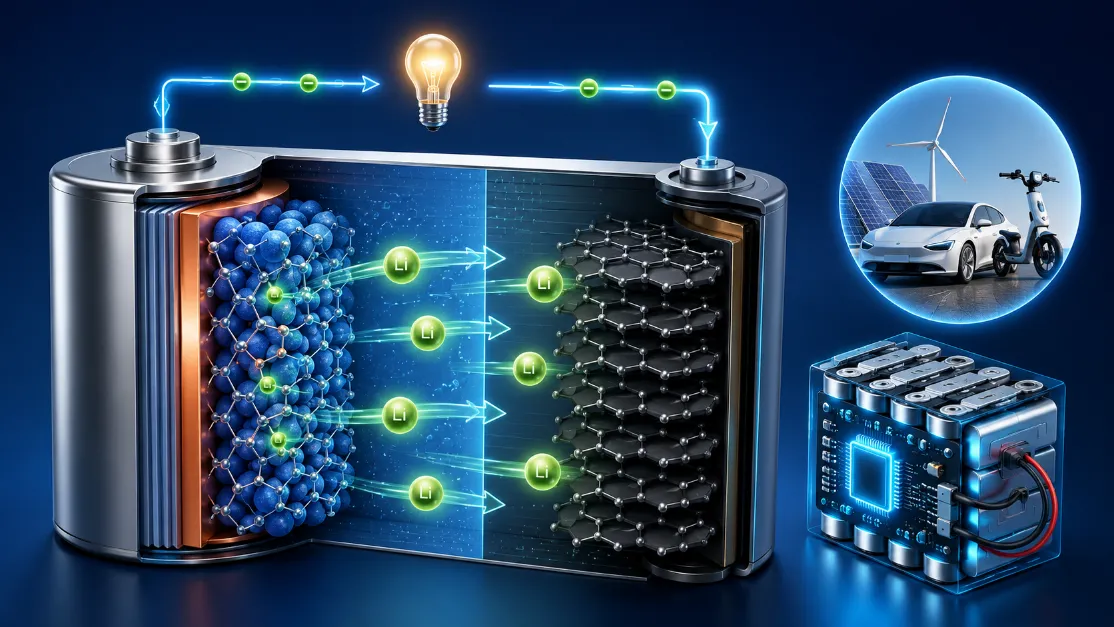
How Lithium-ion Batteries Work
From the smartphone in your hand to the electric vehicles cruising down our streets, one unsatiable piece of technology quietly powers our modern world: the lithium-ion (Li-ion) battery.
But have you ever paused to think about what’s actually happening inside that sleek metal casing? How does it store power, and why has it become the gold standard for everything from electronics to green transportation?
Let’s break down the science of how lithium-ion batteries work, minus the dense textbook jargon.
The Anatomy of a Lithium-ion Battery
To understand how these batteries work, think of them as a highly organized, microscopic game of ping-pong. A standard lithium-ion battery consists of four primary components:
- The Anode (Negative Electrode): Usually made of graphite, this is where the lithium ions hang out when the battery is fully charged.
- The Cathode (Positive Electrode): Made of a lithium-metal oxide compound (like Lithium Cobalt Oxide or Lithium Iron Phosphate), this is where the ions rest when the battery is discharged.
- The Electrolyte: A liquid or gel chemical medium that allows lithium ions to move smoothly back and forth between the anode and cathode.
- The Separator: A micro-perforated plastic film that keeps the anode and cathode from touching (which would cause a short circuit) while letting the tiny ions pass through.
The Back-and-Forth: Charging vs. Discharging
The magic of a lithium-ion battery lies in the movement of lithium ions ($Li^+$) and electrons.
1. Discharging (When you are using your device)
When you turn on an e-rickshaw or use your phone, a chemical reaction occurs. The lithium ions stored in the graphite anode release electrons.
- The ions travel through the internal electrolyte to the cathode.
- The electrons, however, cannot pass through the separator. Instead, they are forced to take the long way around via an external circuit. This flow of electrons is what creates the electrical current that powers your motor or screen.
2. Charging (When you plug it in)
When you connect the battery to an external power source, the process reverses. The electrical energy forces the lithium ions out of the cathode, back through the electrolyte, and forces them to wedge themselves into the graphite anode. The battery is now packed with potential energy, ready to be used again.
Why Lithium-ion Rules the Market
Before Li-ion took over, we relied heavily on Lead-Acid and Nickel-Cadmium batteries. Lithium-ion changed the game for three major reasons:
- High Energy Density: They can store a massive amount of energy in a relatively small, lightweight package.
- Low Self-Discharge: They lose very little of their charge when sitting idle compared to other battery types.
- Long Cycle Life: They can be charged and discharged thousands of times before their performance significantly degrades.
Powering the Green Revolution: The E-Rickshaw Boom
In regions like India, lithium-ion technology isn't just powering gadgets—it's driving sustainable public transit. The e-rickshaw market has experienced a massive shift from traditional, heavy lead-acid batteries to efficient Li-ion packs. They charge faster, last longer, and significantly cut down the weight of the vehicle, offering drivers better mileage and higher earnings.
If you are looking for reliable power solutions in India's industrial hub, sourcing from a certified lithium ion battery manufacturer in delhi ncr ensures you get cutting-edge technology tailored to local climate and road conditions.
With the market expanding rapidly, identifying a supplier that ranks among the top 10 e rickshaw battery manufacturer circles guarantees high thermal stability, robust Battery Management Systems (BMS), and excellent warranty support.
The Bottom Line
Lithium-ion batteries are a masterpiece of electrochemistry. By simply moving ions back and forth, they provide the clean, portable energy needed to decouple our world from fossil fuels. As manufacturing hubs in Delhi NCR and across the globe continue to innovate, we can only expect these powerhouses to become safer, faster-charging, and even more efficient.