
Understanding the Construction & Working Principle of Lithium-Ion Batteries
From the smartphone tucked in your pocket to the drones buzzing across agricultural fields, lithium-ion (Li-ion) batteries are the undisputed powerhouses of the 21st century. Their ability to pack incredible amounts of energy into compact, lightweight frames has revolutionized modern technology.
But what exactly happens inside these sleek power cells? In this blog, we’ll peel back the layers to understand the internal architecture and working principles of lithium-ion batteries.
1. Inside a Lithium-Ion Cell: The Core Components
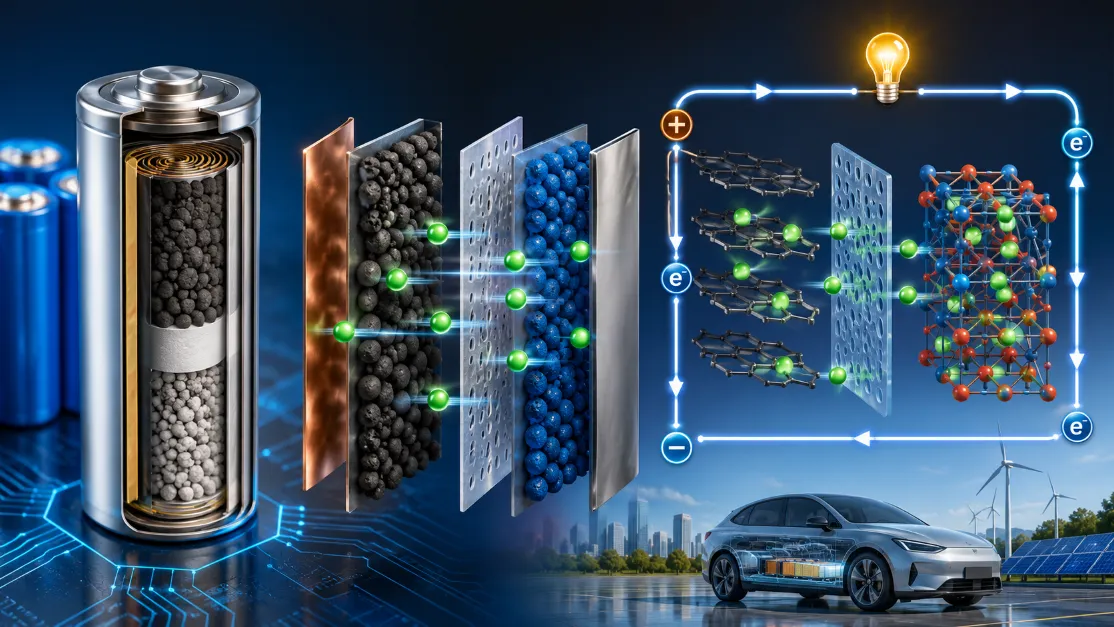
A lithium-ion battery isn't just a solid block of chemicals; it is a precisely engineered system made of four foundational components:
- The Anode (Negative Electrode): Typically made from carbon/graphite, the anode acts as the host storage unit for lithium ions when the battery is fully charged.
- The Cathode (Positive Electrode): Made from a lithium metal oxide (such as Lithium Iron Phosphate ($LiFePO_4$) or Nickel Manganese Cobalt ($NMC$)), the cathode determines the battery’s overall voltage and capacity.
- The Electrolyte: A liquid or gel solvent containing dissolved lithium salts. It acts as the highway, allowing lithium ions to move freely between the anode and cathode.
- The Separator: A micro-porated plastic film positioned directly between the anode and cathode. It allows tiny lithium ions to pass through but blocks electrons, preventing a catastrophic internal short circuit.
2. The Working Principle: Charging and Discharging
The fundamental science of a Li-ion battery revolves around a process called intercalation—the reversible insertion of ions into a host material's structure. Think of it as a chemical game of ping-pong.
Phase A: Discharging (Using Power)
When you connect your battery to a load (like turning on a device), a spontaneous chemical reaction takes place:
- Oxidation occurs at the graphite anode, releasing electrons and converting lithium atoms into lithium ions ($Li^+$).
- The lithium ions travel internally through the electrolyte and separator toward the cathode.
- The electrons, unable to pass through the separator, are forced through the external circuit. This flow of electrons creates the electrical current that powers your device.
The chemical equation at the anode during discharge can be represented as:
$$LiC_6 \rightarrow C_6 + Li^+ + e^-$$
Phase B: Charging (Storing Power)
When you plug the battery into a charger, an external electrical voltage forces this process into reverse.
- Electrons are pushed back into the anode from the external power source.
- Lithium ions migrate back out of the cathode, through the electrolyte, and slip back between the graphite layers of the anode, waiting to be used again.
3. Advanced Engineering: Binders and Current Collectors
To keep everything working smoothly, the active anode and cathode materials are coated onto metallic current collectors.
- Copper foil is used for the anode.
- Aluminum foil is used for the cathode.
To ensure these active chemical powders stick tightly to the smooth foil current collectors during thousands of expansion and contraction cycles, manufacturers use specialized chemical binders.
Understanding these strict chemical requirements is why choosing a top-tier manufacturer matters. Companies sourcing high-performance energy storage units often partner with a trusted top lithium ion manufacturer in india to ensure precision in chemical mixing, cell balancing, and long-term cycle reliability.
4. Expanding Frontiers: The Rise of Specialized Custom Batteries
As technology evolves, the construction of Li-ion batteries is being adapted for highly specialized, demanding applications. Take unmanned aerial vehicles (UAVs), for example. Unlike an electric car that needs steady, sustained energy, a drone requires a battery that is incredibly lightweight yet capable of delivering sudden bursts of massive current to stay airborne or fight strong winds.
Achieving this delicate balance of high energy density and extreme C-ratings requires a specialized Drone Battery manufacturer and suppliers who can customize the internal chemistry and implement advanced Battery Management Systems (BMS).
Conclusion
The lithium-ion battery is a triumph of electrochemistry. By simply orchestrating the orderly migration of ions and electrons across microscopic barriers, it gives life to our most vital technologies. As the demand for localized, high-tech energy storage scales globally, the engineering behind these batteries will only grow safer, faster, and more efficient.